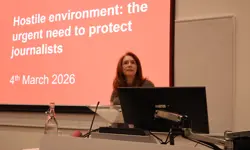
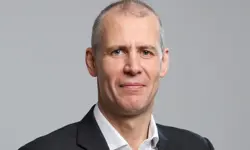
A highlight of the Society of Editors Media Freedom Conference 2025 on March 25th came when the BBC’s legendary international editor, Jeremy Bowen, collected the society’s coveted Fellowship Award with a gracious thank-you speech but with a grim sting in its tail.
Asked by me, among others, whether he was optimistic or pessimistic about the prospects of justice for the people of Ukraine and Gaza in the age of Trump 2.0, his stark response was ‘very pessimistic’. In fact, the name of Donald Trump was often the spectre at a conference feast full of thought-provoking panels ranging across topics such as, ‘Can AI Transform Journalism Without Losing Its Soul?’, ‘How Can We Keep Journalists Safe?’, ‘Is Trust Being Restored Between the Police and Media?’.
But time and again, from both the stage and the audience floor, the impact of Trump’s return to power and its potential impact on the UK media and democracy reared its head with a keynote speaker Mark Landler, the New York Times London bureau chief, offering a sharp insight into a story dominating the day’s international news agenda — the security scandal over how some of Trump’s top team, including VP JD Vance and National Security Adviser Mike Waltz and Defence Secretary Pete Hegseth included Atlantic magazine editor Jeffrey Goldberg in a top-secret group chat about planned military strikes against Houthi rebels in Yemen. For his part, Landler — who has covered Trump over the years — is no more optimistic than Jeremy Bowen over Ukraine and Gaza.
The ‘chat’ scandal also contained further inflammatory remarks by Trump’s top team crudely denigrating Europe yet again and questioning whether it was worth the US defending its NATO allies. It all coincides with British newspapers being forced to re-evaluate hopes that Trump 2.0 would somehow turn out to be an improvement on Trump 1.0.
Max Hastings’ view
Thumbing through the national and major regional papers on display at the conference, you couldn’t help but be struck by a searing column by historian and former Telegraph Editor Max Hastings in The Times headlined, ‘Be honest about what’s needed in Ukraine’.
The opening paragraph set the tone and you suspect Jeremy Bowen would have approved: “Almost the only foreign leader not emitting flatulence about Ukraine is Vladimir Putin. Russia’s dictator says what he means and means what he says. He will accept nothing less than victory, because he believes Donald Trump is going to give it to him. We need not here reprise the president’s stated views, which shame the US. His special envoy said on Saturday, “I don’t regard Putin as a bad guy. He’s super smart”.”
Witkoff’s remarks sparked understandable outrage in Ukraine and sent a collective shiver down the spin of Europe. Witkoff’s only qualification as a peace-negotiating diplomat is that he’s a golf-buddy of Trump and a fellow property tycoon with, like his boss, precious little grasp of facts or history and an enthusiasm for swallowing Putin propaganda.
Hastings’ column continued with brutal candour: “Zelensky and his people seem wonderfully determined to fight on even if the US withdraws its support. The only honourable course for Europe is to back them to the hilt. We, however, lack munitions. The most plausible palliative is to buy them from the US and South Korea. But this proposition bears a big question mark: if Trump announces he has struck a deal with Putin, will he allow us to continue to acquire weapons for Kyiv’s use?
“The US president seek to showcase his mastery on every issue to which he commits. Once he claims that he has settled, even if he in effect signs Ukraine away, it seems unlikely that he will acquiesce in European defiance of his will. We should strain every sinew to succour Zelensky but must recognise the limits of the possible. Our dependence on the US is almost absolute, in everything pertaining to continental defence. Contrary to Keir Starmer’s rash talk, a European peacekeeping force was always a non-starter without the US. Witkoff dismisses the idea in the familiar anti-diplomatic language of the Trump administration as a ‘posture and pose’ by the prime minister. If the whim took Starmer to frighten the Russians with Trident, he has the theoretical independence to fire it, but the Americans could prevent him from doing so.”
Wearing his historian hat, Hastings concludes his column by comparing to 1940 when Churchill, facing defeat against Nazi Germany, stood in front of his shaving mirror and told his son Randoph, “I think I see my way through... I shall drag the United States in.” In 2025, however, do not stand waiting at the bus stop for the US cavalry. They could be forming an honour guard for Vladimir Putin.”
Andrew Neil’s conversion
But the British paper that most illustrates a shift away from Trump 2.0 welcomer is undoubtedly the Daily Mail. A gripping battlefront dispatch the day before the SOE conference came from David Patrikarakos, alongside Ukrainian troops. The headlines spoke volumes, ‘Front-line Ukrainian soldiers accuse Trump of lying and tell the Mail... The US has betrayed Ukraine, betrayed our democracy — and the values of freedom.”
But it was arguably Saturday March 8th that captured the Mail’s Damascene conversion with an Andrew Neil column headlined, ‘The last seven days have confirmed what those of us who gave Trump the benefit of the doubt have, in our heart of hearts, always feared: That he’s an unprincipled, narcissistic charlatan’. Welcome to the club, Andrew...as some of us who knew Trump well personally long before his presidential days have long argued.
The last three paragraphs of the Neil confessional were excoriatingly eloquent: “There is a difference between peace and capitulation. When it comes to Ukraine, it is not clear Trump knows the difference. What can he care of democracy in Ukraine when he encouraged the mob to overthrow the result of a democratic election in America?
“Those of us who wished for better should have known better. It was on January 6, 2021, that the real Trump was in view for all to see.
“What fools we were not to take him at his own estimation but to think he could amount to something better. We have no right to be surprised that the man who tried to overturn democracy in his own country doesn’t give a damn if it’s now snuffed out in Ukraine.”
Neil weighed in again following the Trump team’s ‘Keystone Cops’ security blunder with a full frontal Daily Mail column (March 26) headlined, ‘If Europe’s leaders don’t realise they’re on their own after these leaks from Trump’s cast of clowns, they never will’. He warned rightly that the Vance / Trump brigade now display a “visceral anti-Europeanism” and “have gone from mere animosity to outright hostility”. None of which augurs well for Ukraine’s prospects or indeed those of Europe with a White House administration increasingly more intent on building bridges to Putin rather than committing to its longstanding European NATO allies.
Boris torn
By contrast, on March 15th, Neil’s fellow Mail columnist Boris Johnson — schizophrenically torn between being Trump fan boy and Zelensky hero worshipper — produced a column headlined, ‘I trust and believe Trump WILL hit Putin with every shot in his locker — he can’t let the world think he’s lost to a cowardly mass murderer.” Fancy a bet, Boris?
Apart from a relatively mild social media condemnation of Trump’s Ukraine stance, Boris’s subsequent Mail columns have rather steered clear of the topic. Quelle surprise.
Or, as one Trump-sceptic senior Capitol Hill Republican put it to me recently: “He is convinced he’s the unbeatable ‘Art of the Deal’ master. And even when Putin, who holds all the best cards, outplays him, he’ll still delude himself he’s won. And when you now think you’re more King than mere President and you’ve surrounded yourself with courtiers, cronies and cowards prepared to destroy the US constitution and too scared to speak truth to the power, selling Ukraine or even the whole of Europe down the rivers matter not.”
The morning after the conference, The Times leader hit the nail on the head under a one-word headline, ‘Trumped’. It argued the, “US administration’s willingness to make concessions to Vladimir Putin for little actual gain risks handing the dictator the victory he has so far failed to secure” but the final lines echoed the genuine gloom gripping Kiev, “So far, Mr Putin is winning at the card table. The Americans appear intent on rehabilitating Russia and sealing a deal at almost any price, with Ukraine settling the bill.”
Over drinks at the end of the conference, a young media student guest approached myself and a senior British broadcasting executive friend and posed a couple of questions. One was, “Are there any similarities between Trump and Zelensky?” For a few seconds, we were stumped before coming up with the ironic thought that without television neither man would have become a president. In Trump’s case, cast as the dictatorial boss of The Apprentice and in Zelensky’s playing a sitcom president of Ukraine before becoming the real thing, facing the biggest. bloodiest European conflict since the Second World War. No prizes for guessing which one we labelled a hero.
So, what issues do you think will dominate next year’s editors’ conference, our young student pressed. “I’m certain Trump and Zelensky will figure even higher,” I suggested to her. My broadcast exec friend looked at us both and added: “But only one of them is guaranteed to still be around.” Alas, no one was in any doubt who the casualty would be.
More information about the Society of Editors conference, including pictures from the day, can be found here.