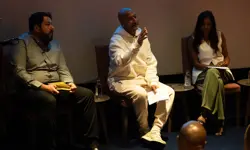
When Pippa Crerar was at school, she wondered whether she should become a doctor or an architect.
As a student studying English at Newcastle University, she had only tenuous links with student journalism, reviewing plays because she loved the theatre, and journalism provided the free tickets she couldn’t otherwise afford.
It was more “a lifestyle choice than a career choice,” Cerar says now.
It was however a first step, however modest, for the political editor of The Guardian who has had more scoops, including the Partygate stories that helped bring down Prime Minister Boris Johnson, and who has won more journalism awards than you could shake a stick at.
Back then, the young Crerar sat and thought about what she was interested in that might point in the direction of a future career.
“I was interested in what was going on in the world and I wanted a ringside seat and I was also, as my friends know, really nosey. So, journalism it was,” says Crerar who went on to study journalism at City University.
[SH]Destination Westminster
That was the journalism decision sorted but why political journalism which she has spent most of her career pursuing at the Evening Standard, the Daily Mirror and The Guardian?
“If you want to be a journalist, you want to get as close to power, to hold power to account and scrutinise power, then there is only one place to do that and that is Westminster. For twenty-five years, there is nowhere else I would rather have been,” says Crerar.
That was then, but if she wants to continue to have a ringside seat at the prime ministership of Andy Burnham, she might find herself having to split her time between Manchester and Westminster in future.
She has certainly had a ringside seat at the rise and fall of Prime Minister Sir Keir Starmer complete with scoops along the way.
In May, she was chosen as the political journalist of the year in the Brutish Press awards for scoops on everything from climbdowns on the winter fuels payments to government plans to increase taxes.
Like most in the media, Crerar felt a great deal of expectation when Sir Keir ended 14 years of Conservative rule even though his victory was subsequently described as “a loveless landslide”.
Great change was promised with different policies and different personalities at the top. It was an exciting time to be a political journalist.
“It was almost like a blank sheet and we looked forward to seeing how the government filled it in, and scrutinising that and holding the government to account along the way,” she explains.
“I certainly didn’t expect it to fall apart in such a dramatic way after only a couple of years,” Crerar admits.
As you would expect, the seasoned political editor of The Guardian is determined to be fair to Sir Keir and emphasises his difficult economic inheritance – everything from stagnating wages to the soaring cost of living. On top of that there was the political inheritance and the fall in public faith in the political system.
“With the appointment of every prime minister, there was a downward political trajectory. It was a very difficult culture to inherit when everything you say and do is treated with scepticism or even worse cynicism,” Crerar notes.
On top of that, there was the international backdrop that would have made it difficult for any prime minister – everything from dealing with President Donald Trump, the Russian invasion of Ukraine, the Middle East and the future of Iran with its impact on energy prices.
There was another issue, Crerar emphasises, that added to the air of inevitability. It was the large intake of new Labour MPs who had never experienced the ups and downs of the political cycle. They were spooked by the large local election losses in the face of the rise of Nigel Farage’s Reform UK and were fearful of losing their jobs at the next election.
[SH]Nice guy, but…
“They thought that Sir Keir Starmer with all his flaws can’t be the man to lead us into the next election. The herd has moved as Boris Johnson said,” Crerar explained.
The character flaws and political mistakes made Sir Keir Starmer’s downfall appear all but inevitable.
Sir Keir may be a nice guy who plays football “but he didn’t have the ability to communicate and connect with the public. He didn’t feel relaxed, he didn’t feel authentic and he always struggled with articulating his vision.”
According to Crerar, he didn’t even have the ability to connect with his MPs.
“He didn’t properly engage with his own MPs. He didn’t see the point of it. There were still Labour MPs who had never met him. He thought the politics of it slightly below him.” Crerar explains.
When it came to the crunch, Sir Keir had very little political goodwill to rely on.
Then there were the clear mistakes, some larger than others, made despite coming to Downing Street promising that standards were going to be different.
The biggest was probably the appointment of Lord Mandelson as British ambassador to the US, something which Crerar believes you can argue retrospectively was designed to find someone who could deal with Trump but the warning signs had been clear.
On the doorstep, two issues resonated – the paid for suits and glasses which made Sir Keir look like someone on the take and the cuts to winter fuel allowances for pensioners.
“The worst thing the government could have done was to cut welfare for pensioners,” says Crerar who got the exclusive on the government’s enforced u-turn on the issue.
“The public doesn’t mind u-turns if they think the government got to the right place eventually but it does cast doubt on its own political judgement,” she adds.
The Guardian political editor tells of a comment Sir Keir is said to have made about what he saw as his greatest achievement running the Department of Public Prosecutions – it was that he had digitised the department’s processes.
Another small example of a technocratic approach rather than a bigger vision.
“He was more focussed on the here and now rather than the journey he wanted to take the country on. When he did talk about where he wanted to take the country, he came across as less authentic than you would want from a prime minister,” Crerar says.
[SH]Next up, Burnham
Will Crerar and her colleagues in the lobby now be sharpening their pencils to scrutinise the new world of Burnham?
“It is our job. The media gets blamed for bringing down politicians but it is our job to report on their failings and report on public dissatisfaction,” says Crerar although she concedes that the media is not faultless.
“The mainstream press, The Sun, the Daily Mail and The Times were all gunning for Sir Keir Starmer from day one and didn’t give him the respect that they would have given a Tory leader,” she adds.
Add to that the pace of the 24-hour news cycle that feeds into public impatience for instant solutions to long-term, intractable problems and the transformation created by the rise of social media.
At Westminster, the social media of choice is still X – Twitter as was – yet it is still controlled by Elon Musk, “a right-wing political libertarian using it as a plaything”.
Crerar suggests that the social media operators should have the same responsibility as publishers to provide reliable information but is not hopeful that there would be the cross-party support needed to tackle such an issue.
She believes that Farage accepting the £5 million gift from a Thailand based billionaire being investigated by the parliamentary standards authorities could eventually mean a by-election for Farage in his Clacton constituency.
Crerar believes however if such a thing happens, Labour would have to be very careful to avoid making it seem like a Burnham-Farage contest.
Reform, she notes, is largely a one-man band and if Farage “who looks tired right now” were to decide to have a more peaceful life elsewhere, Reform would fall apart.
Just after Crerar made this comment, in an extraordinary move, Farage decided to resign as MP for Clacton and then stand in the resulting by-election.
But even if Reform were to lose in this or other bizarre manoeuvres and then implode, there would still be a populist right sized hole in British politics. The Guardian political editor believes it is a hole that Conservative leader Kemi Badenoch would seek to fill “by being a cultural warrior” rather than focussing on economic policy.
[SH]Cultivating relationships
As for political journalism, Crerar believes it is all about relationships.
“You live or die as a political journalist by your relationships,” she says.
“I have never been someone who will go with a flier or turn someone over. I really believe it is important to be respectful and kind where you need to be and I don’t think you have to have friction and toxicity to be effective in journalism,” Crerar adds.
She believes that you can still have massive scoops while still having the reputation of being “a decent and fair person”.
But where does she think British politics and Prime Minister Burnham will be in two years – one year before the likely date of the next general election?
It is possible, she believes, that by then, the Labour Party having discovered its capacity for regicide, might have moved on to someone else as leader.
“However, if you talk to Labour MPs, and not anything to do with Andy Burnham and his skill set, Labour MPs are so clear in their minds that this is the final roll of the dice,” she says.
“They have to make this work and if they don’t make this work and Andy Burnham isn’t the right leader, they’re stuffed,” predicts Pippa Crerar, political editor of The Guardian.